Injection Treatment of the
Greater Saphenous Vein
by Ken Biegeleisen, M.D.
|
NOTE: Some of the the following sections are complex, and involve information which many doctors do not know! You do not have to read it all! All patients, however, must read the three sections numbered XIV-XVI. They discuss the question of "saving" varicose veins for use in bypass surgery.
TABLE OF CONTENTS |
|
I. |
|
|
II. |
|
|
III. |
|
|
IV. |
|
|
V. |
|
|
|
|
|
VI. |
|
|
|
|
|
|
|
|
VII. |
|
|
|
|
|
VIII. |
|
|
IX. |
|
|
X. |
|
|
XI. |
|
|
XII. |
|
|
XIII. |
|
|
|
|
|
|
ALL PATIENTS ARE REQUIRED TO READ THESE SECTIONS: |
|
|
|
|
XIV. |
|
|
XV. |
|
|
XVI. |
|
|
|
|
|
|
THE FOLLOWING IS OPTIONAL!
|
|
|
|
|
XVII. |
![]()
Injection Treatment of the
Greater Saphenous Vein
by Ken Biegeleisen, M.D.
|
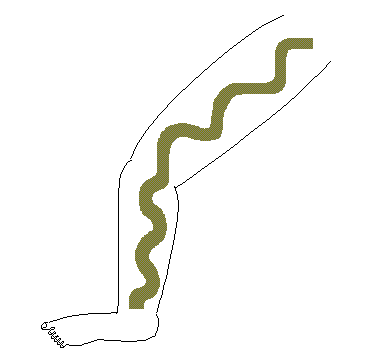
Most people think that any vein which is big and ugly is a varicose vein. This is not a very scientific definition, but the truth of the matter is that it's really not that long ago that the doctors themselves thought this way! But with the advent of ultrasound and other fairly sophisticated medical instruments, this "definition" of varicosity has become woefully inadequate. If we add, to "big and ugly", the requirement that the vein be tortuous, then we are a little closer to a scientific definition of varicose vein. "Tortuous" means that the vein twists back and forth, so that it's a little like a snake sitting on your leg: |
|
|
|
|
|
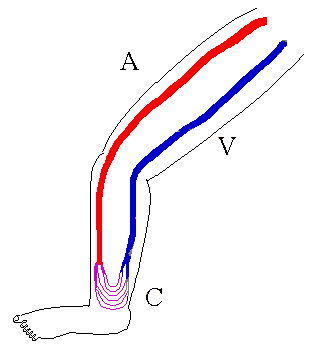
Thick-walled vessels called arteries (the red ones, labeled "A") carry blood into the leg. Once there, the blood moves into a vast network of tiny, tiny capillaries ("C"), from which oxygen, passing right through the ultra-thin vessel walls, is delivered to the surrounding tissues. Then, when all the oxygen has been removed , the blood collects into ever-larger veins (the blue ones, labeled "V"), to leave the leg and return to the heart and lungs for more oxygen. Physiologists refer to the movement of blood out of the leg as venous return. If you think about it, you'll immediately realize that it's a lot harder to get blood out of the leg than in. The trip down, from the heart to the leg, is downhill, and therefore gravity-assisted. But the trip back is uphill. To make matters worse, the driving blood pressure is much higher in the arteries than in the veins. In actual fact, the blood pressure in veins is NOT ENOUGH to move blood uphill, against gravity! So how, then, does the blood get out of the leg? Believe it or not, medical science cannot give an entirely satisfactory answer to this question! But there's quite a bit that is known about it. To make a long story short, the muscles of the leg provide much of the driving force for venous return. When you're lying down, your leg doesn't need to overcome the pull of gravity - it's only when you're standing up that there's a problem. But when human beings stand for any length of time, it's usually because they're going somewhere; i.e., walking. The contractions of the leg muscles during normal walking provide much of the driving force for venous return. Do you recall how tired your legs feel when you have to stand still for long periods of time, e.g. while waiting on a long line to get into a movie? Have you ever wondered why? After all, when you're standing still on a line, you're not really working. So why should you feel tired? The answer is that your leg muscles are not contracting much, and the venous blood therefore collects in the feet and ankles, stagnating. As long as you stand still, a normal body waste product called lactic acid builds up faster than your venous circulation can clear it away, and it's the lactic acid that makes your legs feel tired. If you stand for even longer, then the lactic acid level can exceed a certain critical limit, above which you can even get a painful leg cramp. That's why all the health magazines and TV shows recommend walking and other leg exercises for varicose vein sufferers. But there's another critical factor in venous circulation - valves. It's not enough for the leg muscles to pump, because walking is an intermittent process, and when you step from one leg to the other, the muscles of the first leg relax. Then, all the blood which the first leg worked so hard to pump up, will start to fall back down -- unless, that is, something prevents this from happening. The things which prevent this are the valves. Here's what they look like: |
|
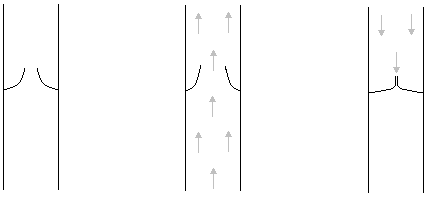
This drawing shows a schematic representation of venous valves. They are purely mechanical, and require no energy to work. The drawing has three parts. On the left is a cross-section of a vein, containing one valve. The valve has two parts, called cusps. As the middle drawing hopefully shows, when blood tries to move up (i.e., the normal direction), the valves automatically open. But if the blood tries to go back down (right-hand drawing), the valves snap shut. In a varicose vein, the diameter of the vein gets steadily larger through the years, until a point is reached where the valves fail. It looks something like this: |
|
|
|
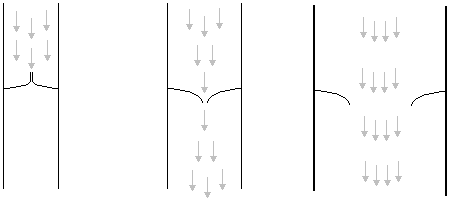
The first drawing, on the left, is the normal situation. Here, when blood tries to flow backward (i.e., downward, toward the foot), the valve cusps snap shut. In the middle drawing, however, the vein has enlarged, and the valve cusps are having trouble holding back the column of blood against the pull of gravity. Some blood leaks through. In the right-hand drawing, the vein is grossly enlarged, and the valve cusps are now merely useless appendages taking up space on the vein wall. They are not large enough, relative to the size of the vein, to have any effect at all on the direction of blood flow. When the patient stands up, gravity will pull all the blood downwards, toward the feet. This is backwards relative to the normal direction of blood flow in veins. This is now a full-fledged varicose vein. This is the hallmark of a varicose vein, and the best definition of one: In a varicose vein the blood flow is REVERSED. Instead of serving the normal purpose, which is to move blood up, and out of the leg, a varicose vein takes in blood from surrounding veins and moves it BACK DOWN into the foot, whenever the patient assumes the upright posture. Whether or not the vein is ugly is therefore entirely irrelevant. If the vein looks good, but carries blood backwards, then it's a varicose vein no matter how pretty it looks. |
|
III. "Doctor, don't I need that vein?" Many patients express concern that removal of varicose veins will have some sort of adverse effect on their health. This is an understandable fear. After all, varicose veins are often very large, dramatic-looking vessels. They must be doing something, no? No! If you have understood the previous discussion, then you now know that varicose veins carry blood backwards. This does your body no good whatsoever! Think of the work your body must do to pump blood up, in the normal direction, from the leg back to the heart and lungs. This is work done against the pull of gravity. It's hard work! Now consider this: every drop of blood which enters a varicose vein enters from the top, and runs back down to the foot. This is backwards! It's entirely contrary to the normal flow of blood, and it does no good whatsoever! In fact, varicose veins are a significant impediment to normal circulation. In severe cases, the disturbance to normal blood flow can be so severe that the leg will ulcerate. Such ulcers, if not properly treated, can become chronic. I've seen patients who walked about with open sores on their legs for over 5 years, before they found a doctor who knew how to treat them. And it was all from varicose veins. That's why we say that there is no harm in removing a varicose vein: In most cases the patient will look and feel better, and tests of the quality of venous circulation will show a substantial improvement! But now you may be wondering whether perhaps doctors should be attempting to repair the vein, instead of simply removing it. This has been tried by pioneering vascular surgeons. The most recent effort involved placement of synthetic bands around the vein at the sites of the valves. This pressed the valve cusps together, restoring the competence of the vein (see the drawings above if you forgot what a valve cusp is). Unfortunately, within 2 years, the veins failed again! Considering all the effort, expense, and suffering involved in such surgery, this outcome was extremely disappointing. Consequently, this operation is rarely performed. Therefore, if the vein is seriously diseased, it's best to simply remove it (by injections or surgery). Besides, the veins which typically go "bad" in people with varicose veins are unimportant veins, even in health. The human body is built in such a way that all vital vessels are deep. Varicose veins, on the contrary, are surface vessels, and all surface vessels are EXPENDABLE. Normally, the total contribution of all the surface veins of the leg is no more than 5-10% of the venous circulation, and, if necessary, every bit of that can be re-routed to the deep veins, which have tremendous reserve capacity. It is entirely possible to remove every visible vessel from the surface of the human body, without serious circulatory disturbances resulting. This, again, is because all the vital vessels are deep. There are no essential blood vessels visible on the surface of the human body! Therefore, at the present time, the only reason to refrain from operating upon (or injecting) a serious varicose vein problem is the theory of saving veins for arterial bypass surgery later in life. This is dealt with in a later section.
|
|
2. Abnormal hook-ups between blood vessels Varicose veins may be caused by things called arteriovenous communications, which means places in the circulation where arteries and veins are hooked up without any capillaries in between. If necessary, please refer back to the drawing and discussion in Section II ("Physiology and pathology of veins"), where it was pointed out that the pressure in arteries is higher than the pressure in veins. This is because the heart does a lot of WORK pumping blood down to the body's billions of capillaries, and when the blood collects in veins for the trip back, the pressure is mostly "used up" already. What would happen if an artery and vein were connected directly together, without capillaries in between? Theoretically, the pressure in the vein would rise. In fact, that's exactly what happens. There's a man-made situation where this may be directly observed. For patients whose kidneys have failed, modern medicine now offers "dialysis". This is a large machine through which blood is pumped. Exactly what happens within the machine is unimportant to our present discussion. The important thing is that patients without kidneys need to have their blood "cleaned up" several times per week, and in order to accomplish that, all of their blood must be pumped through a dialysis machine. In order to filter a person's entire blood volume, you need access to a large blood vessel, at least twice a week. Which vessel will you use? The veins on the arms, legs, and hands are much to small for this purpose! So what will the doctors do? Cut you open every three or four days, to find a large vessel? Of course not. But they do employ surgery -- once! They open up the wrist, and find a small artery inside. Remember, an artery is a high-pressure vessel. Then they connect it to a small surface vein on the arm. Now all the arterial pressure is transferred to the surface vein. Voila! Within a matter of days, the surface vein blows up like a balloon! Now the patient has a huge vein, right there on the surface. When this vein is connected to a dialysis machine, it is large enough to allow rapid passage of all the blood in the patient's body to enter the dialysis machine, get "cleaned up", and return back to the patient, within a reasonable period of time. So it's true that connecting an artery to a vein makes the vein blow up, sometimes literally "like a balloon". But does this have anything to do with varicose veins? Throughout the 20th century, certain doctors have claimed that varicose veins are caused by arteriovenous communications. In fact, it's now known that they exist in the legs, but only in the legs of varicose veins patients. A well-known vascular surgeon, Lars Schalin of Sweden, has identified them by operative microscopy. They're there, and there are lots of them. In our own office, we have identified arteriovenous communications by angioscopy, a procedure which looks directly into a vein. So the arteriovenous communications do exist. And it's a fact that connecting an artery to a vein raises the pressure in the vein. So here's an entirely plausible explanation for varicose veins. Unfortunately, although the arteriovenous communications are there, they are small. Some say that they are too small to cause disease, the very largest of them being no more than 1/2 millimeter in diameter (about one-fiftieth of an inch). The skeptics are therefore willing to admit that the arteriovenous communications are there, but they say that they are secondary. Hmmm ... there's that word again. It means that maybe the varicose veins appeared first, and then the arteriovenous communications came later. So it's just like the situation with the altered wall chemistry. It's there, but was it the cause of the disease, or was it caused by the disease? "What came first, the chicken or the egg?" No one knows! |
|
3. Disease of the deep veins Seshadri Raju, a prominent vascular surgeon, proved years ago that every patient with varicose veins has disease of the deep veins. When we say "varicose vein", we're always talking about a vein which is either visible on the surface of the leg, or just under the skin. So what Raju is telling us is that in patients with surface varicosity, the deep veins, which we cannot see or feel, are also diseased, even if it does not seem so from simple observation and physical examination. Raju proved this using a sensitive technique called "descending venography", which detects very subtle dysfunction in the deep veins. After making this discovery, Raju proposed that all varicose veins are secondary to (i.e., caused by) disease in the deep veins, the latter being a condition which doctors often refer to as chronic venous insufficiency. Chronic venous insufficiency is very similar to varicose veins, in that the main manifestation of the disease is valve dysfunction (if necessary, see the drawings in Section II, "Physiology and pathology of veins"). Only here, it's in the large, vital veins deep in the leg; not merely in unsightly surface veins. Unfortunately, even if it proves true that the real cause of varicose veins is disease in the deeper veins, this leaves many questions unanswered. Why did the deep veins "go bad"? Thus, all the same questions come up again! Do the deep veins have abnormal wall chemistry? (Yes -- they probably do). Are there arteriovenous communications in the deep veins? (Yes, there are. But no one knows whether they are primary or secondary!). I hope you can see that the question "What causes varicose veins?" is far from simple. Although we know a lot about it, our knowledge is not enough to provide a simple answer, or a simple cure. In summary, there are at least three things which can cause varicose veins. Whether any one of them is more important than the other two is not known. It may even turn out that varicose veins is more than one disease, with different cases resulting from different causes. So, you see, we really don't know what causes varicose veins. But we treat them anyway! |
|
Once it's determined that you need treatment (or you simply want treatment), the obvious next question is "which one?". This question has been batted around by doctors for well over 100 years, and the definitive answer is not in yet! Nor do I expect it to be in our lifetimes! The first possibility is "no treatment". If there's no serious problem right now, then you might as well go home! As explained above, we rarely do prophylactic treatment. But if you're determined to have a good-looking leg, or if your leg aches, or if you have any of the serious complications of varicose veins (bleeding, ulceration, or phlebitis), then you'll need to be treated. But which treatment? |
|
The least invasive treatment for varicose veins is simply to wear a special stocking. These go by various names, such as "surgical stocking", or "gradient pressure stocking". They are only available by prescription. "Support hose", sold over-the-counter, are not adequate (although they may be better than nothing). Because these stockings press hard enough to cut off the circulation in old people or in diabetics, they cannot be dispensed without a doctor's prescription. We will not go into the mechanism of action of these stockings. Suffice it to say that in certain people, they make the legs feel better. These people are often willing to wear surgical stockings forever. But most of our patients aren't. The stockings do not cure the disease, or even change it. They simply make the legs feel better. At night, when they come off, the leg is exactly the same as it was when the day began. Thus, treatment of varicose veins by stockings is life-long. Although the stocking companies have made surgical hose look better and better through the years, they are still unacceptable to most patients, because they are not attractive-looking. |
|
Around 1900 the "stripping" operation was introduced for varicose veins. Its popularity has waxed and waned throughout the 20th century. When the operation was first performed, it was hoped that it would provide a permanent cure for varicose veins. That hope proved to be premature. By 1920, there were so many surgical cases whose veins had grown back that the method was scrapped completely. From about 1920 to 1940, almost every case of varicose veins in the United States was treated by injection! This may come as a surprise to people who think that injection treatment of varicose veins (sclerotherapy) is a "new miracle treatment from Europe". It's not new at all ! But by 1940, after 20 years of vein injections in America, there was a multitude of patients whose veins had grown back. So the surgeons went back to surgery. They changed the operation a bit, and the new, improved stripping operation worked somewhat better than the old one. But then a veritable war began, between injectionists and surgeons. The subject of the war was this question: "Which treatment (i.e., injections vs. surgery) is the one which really cures varicose veins?" This question was not answered until 1956, when H.I. Biegeleisen (the author's father) published a statistical study proving that varicose veins are never cured! All patients, whether they are operated on or injected, eventually grow new veins. But the war continued. The new question was this: "OK; we can't permanently cure varicose veins. But whose treatment (i.e., injections vs. surgery) keeps bad veins away longest?". The medical term here is "remission", i.e., "Whose treatment gives the longest remission?". This question was batted around for around 25-30 years, when it ran head-on into the era of bypass surgery. With ever-increasing frequency, Americans with the heart disease called angina were getting their coronary arteries bypassed (this is described in more detail presently). In angina, the coronary arteries (which carry the blood supply to the heart muscle) become blocked. In the bypass operation, a leg vein is spliced into the coronary circulation, to bring in more blood. The leg vein they usually use is the greater saphenous vein. This is the same vein which is usually diseased in varicose veins! All of a sudden, vascular surgeons started to ask a new question: "Should we save the saphenous vein, just in case the patient needs a bypass operation later?". We shall return to this question shortly. But first, we must consider injections. |
|
Injections for varicose veins go back to at least 1840. They did not become popular until this century, but around 1900 surgery also became popular. Most of the surgeons stopped injecting, and began operating. Injections almost disappeared from the practice of venous medicine. Around 1920, however, the tables turned. As I explained earlier, it had become apparent that surgery (at least as it was done back then) had had a poor long-term outcome. Consequently, injections gradually replaced surgery as the treatment of choice for varicose veins. In vascular clinics from coast-to-coast, all the surgeons were injecting veins. Injections became so popular that the medical literature published insulting commentaries on surgery, going so far as to call any surgeon who ever operated on varicose veins a "barbarian"! Injections reigned supreme for about 20 years, but by the time World War II was over, vein surgery was back. At that point people had finally realized that the problem of re-growth of varicose veins had not been solved by injections. In fact, many surgeons claimed that veins grew in even faster after injections than they had after the old surgery. So, as pointed out earlier, new forms of stripping surgery were developed, and these became widely used, once again, for the treatment of varicose veins. Injections, for the second time this century, became scarce. Starting in the 1970's, new forms of injection therapy were devised in Europe, and they were very gradually introduced to the United States. But it was not until about 1990 that injections had grown sufficiently in popularity that they were once again well-known in this country. Nowadays, injection treatment (sclerotherapy) of varicose veins is widely practiced in America, and its popularity is again peaking. But, as has happened so many times in the past, new developments have occurred which make the task of selecting a method of treatment difficult. One of the most important of these developments came from this very office, and we shall describe it shortly. |
|
There are other ways to bring about sclerosis in varicose veins. In France, cryotherapy with liquid nitrogen was attempted. A cold probe, with liquid nitrogen flowing through the inside, was inserted into the vein, to freeze it. When the procedure was completed uneventfully, the result was good. Unfortunately, sometimes the cold probe got stuck, causing frostbite to the surrounding tissue. Therefore, this approach has remained experimental. In England, veins were sclerosed by applying electric shock through intravenous wires. This also worked well, but the electrocautery machine used was originally designed to burn out bladder tumors; a procedure which required high voltages and currents. Such an instrument was too powerful for routine use in veins. It worked, but it was unnecessarily painful. If a better instrument could be designed, it would have promise for the future. In Russia, an investigator sclerosed a vein by inserting a cat gut suture, and simply leaving it there. It produced a continuous irritation within the vein, which ultimately triggered the body's intrinsic vein-shrinking process (cat gut sutures needn't be removed; they dissolve by themselves after a few weeks). |
|
Since the early 20th century, a combined approach, with some surgery and some injections, has been used. In principle, the long-term remission of surgery and the cosmetic advantages of injections could both be had. In the greater New York area, I know of no surgeons who have first-rate skills at injection treatment, and I know of no first-rate vein injectionists who also operate. Therefore, in New York, the combined approach requires two different doctors. In our practice, we occasionally refer patients to one or another of a very select group of highly-specialized surgeons who have chosen to devote their lives to vein surgery. For patients in whom surgery is indicated, we will refer them to one of these surgeons for an operation. It is almost never medically necessary to operate, because veins can almost always be injected. But in the interests of a longer remission time, we will refer patients out, if it is indicated, and if they are agreeable to surgery. I should point out that most "vascular surgeons" nowadays do NOT specialize in vein surgery! The public believes that vein surgery is part and parcel of vascular surgery, and that simply isn't true! The specialty of "Vascular Surgery" did not even exist until after the Vietnam War, and it was created to serve the needs of surgeons who specialize in "arterial bypass" surgery. Diseases of the arteries and disease of the veins are NOT the same, and patients with one of these forms of disease usually do NOT have the other. Therefore, for the first 20 years, Vascular Surgeons operated almost exclusively on arteries. During this period, most of them looked down on vein surgery as being "beneath their dignity", since it had always been considered part of "General Surgery" -- not something which ought to be done by a specialist. As for training, it was not long ago that Vascular Surgeons had no training at all in veins. Fortunately, things have begun to change, but, on the whole, Vascular Surgery is still heavily concentrated on arterial disease, and remains light on the venous side. Therefore, if we believe that occasional patients really would benefit from vein surgery, we have to be very careful whom we send them to. In my opinion, there are only 2 or 3 really good vein surgeons in the entire greater New York area. |
|
|
|
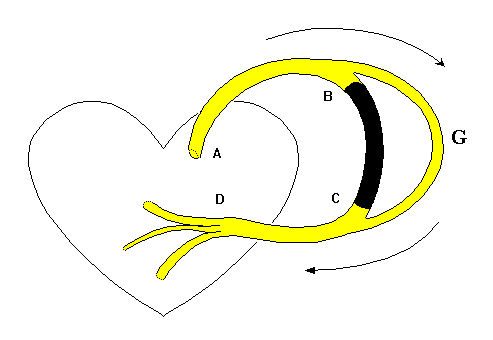
In the drawing above, the normal direction of blood flow is indicated as: A àBàCàD, but the segment "BC" has become completely blocked by atherosclerosis. So the surgeons splice a vein graft (labeled "G") into the coronary circulation to bring blood around the blockage. It's possible (although not necessarily the method of choice) to use a varicose vein for this purpose. So, even though varicose veins are not considered a good choice for graft "G" in the above illustration, they are used on occasion. This raises an entirely new question in every interaction between vein doctors and their patients: should you ever get your varicose veins treated? Or should you save them in case you need them later, for a coronary artery bypass? Here are the "pros" and "cons": |
|
XVI. Arguments AGAINST "saving" the Saphenous Vein 1. "Left Main Coronary Artery" blockages are relatively rare. In my personal experience as a medical resident, during which time I admitted dozens of patients to the hospital for coronary angiography/bypass, not one had an occlusion of the "Left Main Coronary Artery". 2. Patients with both severe heart failure and significant coronary artery blockages are only a small minority among those who receive coronary artery bypass in the United States. In my personal experience as a medical resident, during which time I admitted dozens of patients to the hospital for coronary angiography/bypass, very few had both severe heart failure as well as significant coronary artery occlusions. 3. The great majority of patients who will undergo coronary artery bypass will NOT derive the main benefit which they think they're going to get: prolongation of life, and prevention of heart attacks. That's right, folks. The operation generally does not work, if the definition of "work" is "prevention of heart attacks". Most of the time, the operation does NOT prevent heart attacks. When coronary artery bypass was invented, it was hoped and believed that it would prolong life in cardiac patients. But it didn't. Since its origin, the operation has been the most intensely studied medical procedure in history. The statistics which have been compiled are voluminous. It became quickly obvious, at the outset, that the operation did not prevent heart attacks, and that's what I was taught in medical school. Now, 20 years later, the statistics are even more voluminous, but they still show the same thing: the operation doesn't work! 4. In spite of this, every day in America, angina patients are told that if they don't get this operation, they will die. In the great majority of cases, this is a bold-faced lie. 5. In America, where coronary surgeons can easily make $50,000 per day (that's "per day", not "per year"), massive numbers of coronary bypasses are performed every year. The number is surely in the hundreds of thousands, and possibly as many as a million. In Europe, where many surgeons can earn only a few hundred dollars for doing the same operation, the number of coronary bypasses done is only a small fraction of the number done here in America. Do you think money has anything to do with this? 6. If the operation doesn't save lives, then why is it done? Because it relieves chest pain. The angina, or chest pain of coronary artery disease, is regularly relieved by surgery. But there's an unanswered question: "Why is the pain relieved?". This question arises from the well-established fact that the grafts of one-out-of-seven patients are found to have failed after a year. This means that the bypass in the drawing above (the segment marked "G") has closed off. The coronary circulation, at that point, should have either reverted to its original sick pattern, or maybe even become worse. And yet the majority of these patients still feel fine! Why? 7. It has been proposed that the explanation for the relief of chest pain by the operation may have nothing at all to do with circulation! You see, in order to get to the heart, the surgeon has to cut through the "pericardium", the sheath that surrounds the heart. And that's where all the nerves are. So the theory has arisen that maybe the operation relieves chest pain because the nerves are all cut. 8. It wouldn't be a bad thing to relieve a patient's chest pain by cutting the nerves to the heart, but that doesn't require a prolonged hospital stay -- it could probably be done on an outpatient basis! Moreover, it surely does NOT require "saving" veins!! 9. There is considerable evidence that patients with varicose veins have less chance of needing a coronary bypass than the average American. The statistics supporting this are from this very office. We proved unequivocally that people with varicose veins have lower blood pressure, a disease which is strongly linked statistically with cardiovascular death. We published this in the peer-reviewed medical journal Phlebology (volume 4, pp.191-196, 1989). In the same study, we showed also that people with varicose veins were much less likely to have angina than age-matched people from the general population. It was not possible for us to prove this as a hard statistic. Nevertheless, the evidence was suggestive of a significant negative correlation between varicose veins and coronary artery disease. 10. The conduit (i.e., "tube") usually used in coronary artery bypass is the saphenous vein. For years, certain observers have been asking "Why?" After all, it's not a good graft! The best graft is the "internal mammary artery", a small artery which runs down the inside of the rib cage. The internal mammary artery is, or course, an artery, not a vein. And the life-span of arteries, when used as grafts in the arterial system, is much longer than the life-span of vein grafts in the arterial system. The life-span of a vein, when used as a conduit in coronary artery bypass, is in the 5-10 year range. But an artery can last the lifetime of the individual in some cases. Why, then, are saphenous veins used so much in coronary artery bypass? Because they are easier to get at. It's a matter of convenience! Dissecting free the internal mammary artery from the inside of the rib cage takes longer. And when a surgeon is trying to make $50,000 a day, time is of the essence. If a patient really needed a coronary artery bypass, and if the saphenous vein was not available, then the surgeon might be forced to use the internal mammary artery. Thus, the patient might actually be better off, not worse! 11. It's a known fact that, compared to healthy veins, varicose veins make poor grafts. They're too big, they're too irregular in shape, and their inner linings are often scarred by phlebitis. There's no doubt that they fail as grafts faster than normal veins do. Therefore, many vascular surgeons make little or no effort to save varicose veins, when the veins are causing health problems. But others disagree, noting that although they make poor grafts, they can still be used in desperate situations. Are you going to be in a desperate situation? 12. It's a well-established fact that varicose veins invariably recur. That is, new ones always grow in after the old ones are treated. The phenomenon of recurrence has been studied in depth by the British surgeon John Hobbs, mentioned earlier in this report, whose publication on the subject has remained, for 20 years, the standard of knowledge in the field. Within six years after treatment for varicose veins, most patients have required further treatment. The figure for surgical patients is around 85%. For injection patients, it's at least 95%. That means that unless a patient is going to need coronary bypass within the next 6 years, there's almost no chance of there not being another varicose vein to use as a graft. Therefore, the only patients in whom "saving" the saphenous vein is an urgent consideration are patients in whom the significant possibility of a sudden need for coronary bypass can be foreseen within the next 6 years. On the other hand, if you are a young, healthy person with a normal cholesterol level, no chest pain, a normal electrocardiogram ("EKG"), and no family history of early cardiac death, then saving your varicose veins for use as bypass grafts is probably pointless. 13. Recent studies from our own office have shown that large varicose saphenous veins never completely disappear after treatment. They shrink to a size so small that they can be neither seen nor felt. After they have shrunk thusly, they no longer have any measurable harmful effect on the circulation. And yet, within a year or two, sensitive ultrasound studies invariably show signs suggesting that the shrunken saphenous veins are once again carrying blood. It's a tiny trickle at first. The patient, at this early stage, rarely has any awareness of the recurrence. But by 5-6 years, the vein has grown back, and can again be used as a bypass graft, if the surgeon is inclined to use varicose veins at all. This would have been regarded as a very negative aspect of injections only a few years ago, but now, in the era of bypass surgery, it has turned out to be a potential advantage! You can get your veins treated now, and years down the line, when they grow back, you can get your coronary artery bypass! Some surgeons would object, saying that a recurrent saphenous vein will make a poor bypass graft. They're right. But the original one would have made a poor graft also. 14. Worst case scenario: You need a bypass; the saphenous veins have been injected, and, for some reason, they either haven't grown back, or they just can't be used. What do you do?
Balloon angioplasty doesn't hold up as long as surgery, but it's relatively non-invasive, and can easily be repeated a few years later, if necessary. Critics of laser angioplasty say it doesn't hold up as long as surgery, which is true. But, like its cousin, balloon angioplasty, it can readily be repeated in a few years, if necessary. Laser angioplasty is not done in most medical centers. I'm not sure why. In those centers where it is done, its advocates praise its merits highly.

In short, there are a fairly large number of alternatives to the use of saphenous veins in bypass surgery. One of them, the internal mammary artery, is actually better. The others are not as good, but they'll do in an emergency. But will an emergency arise? In all the years I've been injecting veins, I've heard of no case in which a patient needed a coronary artery bypass (or a leg bypass), and got into any trouble at all because of previous vein injections! Does this mean that it's never happened? No. It's possible that there have been cases, which have not been publicized. But since such a thing would, in all probability, lead to a lawsuit, it seems likely that there would be some talk of it. And there isn't. Therefore, it is my belief that the entire issue of "save the saphenous" is a man-made issue which has been blown way out of proportion. It's my opinion that unless a patient has a relatively clear-cut cardiac risk, saving the saphenous vein for bypass surgery is usually pointless. Obviously, it would not be hard, in a city the size of New York, to find any number of other doctors who either agree or disagree with me.
|
|
|
Ken Biegeleisen, M.D. 212-717-4422 |
|
CLICK "BACK" TO RETURN |